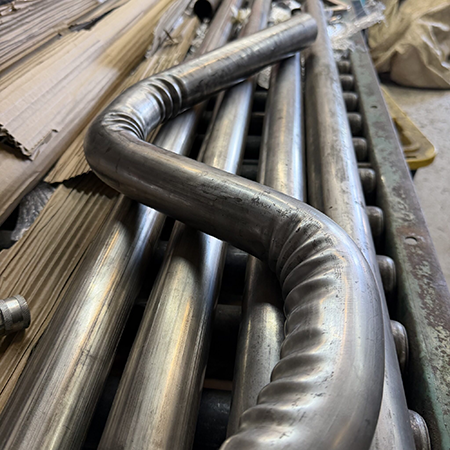
Tube Bending Springback: Causes and How to Control It
author: Huashun Machinery
2026-08-04

Tube bending is widely used in automotive, HVAC, furniture, fitness equipment, hydraulic systems, and heat exchanger manufacturing. Although modern tube bending machines provide high precision and automation, manufacturers still face a common challenge during production — springback.
Springback can cause the final tube shape to differ from the designed dimensions, affecting assembly accuracy, product quality, and production efficiency.
Understanding why springback occurs and how to control it is essential for achieving stable and accurate tube bending results.
Springback can cause the final tube shape to differ from the designed dimensions, affecting assembly accuracy, product quality, and production efficiency.
Understanding why springback occurs and how to control it is essential for achieving stable and accurate tube bending results.
What Is Tube Bending Springback?
Tube bending springback refers to the tendency of a bent tube to partially return to its original shape after the bending force is removed.
During the bending process, the material undergoes elastic and plastic deformation. After the tube leaves the bending die, the elastic deformation is released, causing the tube angle or radius to slightly change.
For example, a tube designed to bend at 90° may slightly open after bending due to material recovery.
Why Does Springback Occur During Tube Bending?
1. Material Properties
Different materials have different springback characteristics.
For example:
- Stainless steel usually has higher springback due to its strength and elasticity.
- Aluminum is lightweight but may experience noticeable deformation.
- Copper has excellent formability but still requires correct bending parameters.
Material selection directly affects bending compensation requirements.
2. Tube Wall Thickness
Wall thickness is another important factor.
Thin-wall tubes are more sensitive to deformation changes and usually require more accurate control of bending parameters.
Compared with thick-wall tubes, thin-wall materials generally experience greater dimensional variation after bending.
3. Bending Radius
The bending radius also influences springback.
A smaller bending radius creates greater deformation, while a larger radius produces less material stress.
Selecting the correct bend radius according to tube diameter and material characteristics helps improve bending accuracy.
A smaller bending radius creates greater deformation, while a larger radius produces less material stress.
Selecting the correct bend radius according to tube diameter and material characteristics helps improve bending accuracy.
4. Bending Angle
The larger the bending angle, the greater the potential springback.
For multi-angle tube components, small errors from each bend may accumulate and affect the final shape.
For multi-angle tube components, small errors from each bend may accumulate and affect the final shape.
5. Incorrect Machine Parameters
Improper settings can increase bending errors, including:
- Bending speed
- Pressure die force
- Boost pressure
- Feeding synchronization
- Rotation accuracy
Modern CNC tube bending machines allow precise parameter adjustment to improve repeatability.
How to Control Tube Bending Springback?
1. Apply Springback Compensation
One of the most effective solutions is springback compensation.
CNC tube bending machines can automatically compensate for expected springback by adjusting bending angles according to material characteristics and previous bending results.
This reduces trial bending and improves production efficiency.
CNC tube bending machines can automatically compensate for expected springback by adjusting bending angles according to material characteristics and previous bending results.
This reduces trial bending and improves production efficiency.
2. Optimize Tooling Design
Proper tooling selection is essential.
Important components include:
- Bend die
- Clamp die
- Pressure die
- Mandrel
- Wiper die
Correct tooling reduces deformation and improves final bending quality.

3. Select Suitable Bending Parameters
Manufacturers should optimize:
- Bending angle
- Bending speed
- Pressure settings
- Feeding speed
- Rotation control
Proper parameter adjustment helps achieve consistent production results.
4. Use CNC Tube Bending Technology
Compared with traditional manual or hydraulic bending equipment, CNC tube bending machines provide higher accuracy and repeatability.
Servo-controlled systems can precisely coordinate:
- Feeding
- Tube rotation
- Bending movement
This helps manufacturers reduce springback errors and improve production stability.

How Huashun CNC Tube Bending Machines Reduce Springback?
Huashun CNC tube bending machines are designed with precise servo control systems and intelligent parameter adjustment functions.
By combining:
- Accurate feeding control
- Stable tube rotation
- Precise bending control
- Springback compensation technology
manufacturers can achieve more consistent bending results for different materials and applications.
Whether producing automotive components, fitness equipment frames, HVAC tubes, or heat exchanger parts, stable bending accuracy is essential for improving production efficiency and reducing material waste.
Conclusion
Tube bending springback is a common challenge in manufacturing, but it can be effectively controlled through proper material selection, tooling design, parameter optimization, and advanced CNC technology.
By understanding the causes of springback and applying suitable compensation methods, manufacturers can achieve higher bending accuracy, lower scrap rates, and more reliable production performance.
By understanding the causes of springback and applying suitable compensation methods, manufacturers can achieve higher bending accuracy, lower scrap rates, and more reliable production performance.
Tube Cutting Methods: Laser Cutting vs Saw Cutting
Why Do Tubes Wrinkle During Bending? Common Causes and Effective Solutions
Related Article

Discover how tube cutting, bending, rolling, and end forming machines help transform metal tubes into components used in furniture, vehicles, fitness equipment, HVAC systems, and industrial products.
How Tube Processing Technology Supports Modern Manufacturing
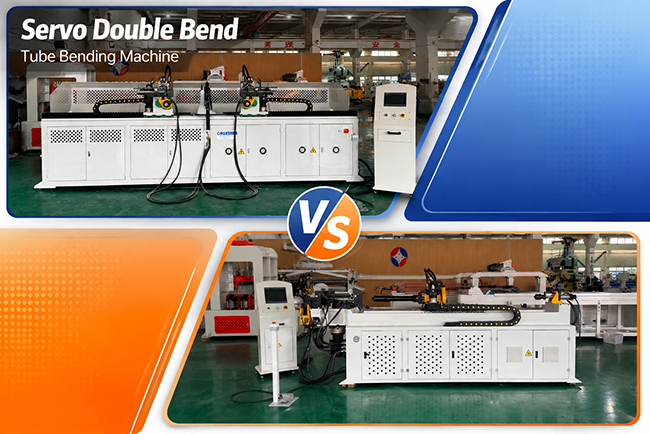
What Is the Difference Between a Double-Bend (Left-and-Right) Tube Bender and a Standard Tube Bending Machine?