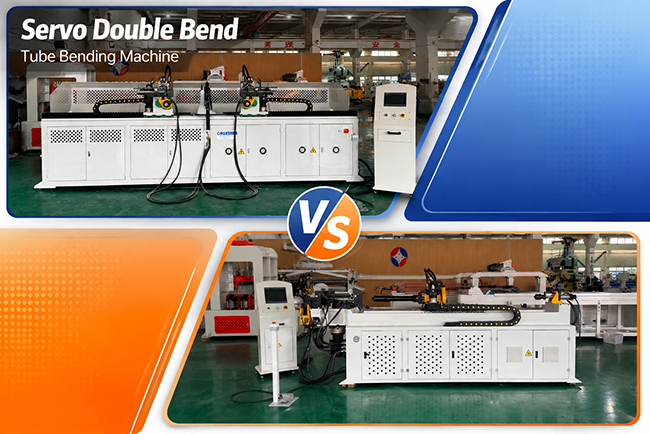
Wire bending Machine Huashun Machinery

Wire bending machine is a device used to bend metal wires into a specific shape or angle. The wire is fed into the working area through the transmission system, and after entering the bending device, the bending of the wire is realized by the mechanical arm, bending wheel or roller. During the whole process, the control system is responsible for adjusting the bending angle, bending radius and bending direction. Commonly used in the manufacture of complex metal parts, such as springs, lattice structures, furniture frames, etc.
1. Bending machine basic structure
Transmission system: usually consists of an electric motor, reducer, drive shaft, etc., used to provide bending power. The power of the motor and reducer output ratio determines the bending capacity of the wire bender.
Feed system: used for automatic feeding, metal wire into the bending area. It can be equipped with an automatic feeding device, wire press wheels, etc. to ensure the accuracy and stability of the feeding.
Bending device: usually includes several bending wheels, clamping devices, etc., which are used to actually perform the bending of metal wires. Bending of wire can be realized in different ways (e.g. roller type, tension type, etc.).
Control system: modern wire bending machines are usually equipped with PLC control system, which can realize precise angle control, speed control and multi-program settings. Users can be programmed to set up different bending programs as needed.
Frame structure: usually using steel plate welding structure to ensure the rigidity and stability of the body to adapt to different types of metal wire bending.
2. Common types of wire bending machine
CNC bending machine: this bending machine using CNC technology, can achieve complex bending shape, applicable to high-precision, high-efficiency production needs.
Automated bending machine: this type of bending machine with automatic feeding and automatic control functions, suitable for mass production occasions, such as springs, automotive parts, home appliance parts.
Single head / double head wire bender: according to the different production requirements, wire bending machine can be configured as a single head or double head, double head models can be bent in both directions, to enhance production efficiency.
3. Key parameters
Maximum Wire Diameter: Depending on the wire, the wire bender can support different sizes of wire from a few millimeters to a dozen millimeters. The common range is 2mm to 10mm.
Bending radius: wire bending machine usually support different bending radius, generally from tens of millimeters to hundreds of millimeters.
Bending Angle: The bending angle can usually be precisely controlled from 0° to 180° or even greater.
Feeding speed: The speed of the feeding system is usually adjusted according to production requirements, generally adjustable from 0.5 m/min to 10 m/min.
Precision: modern wire bending machine control accuracy can reach ± 0.1 mm, to ensure that each bending angle and position of high precision.
4. Common Applications
Spring Manufacturing: Wire bending machines are commonly used to make various types of springs, including compression springs, extension springs, torsion springs and so on.
Metal mesh production: used to produce a variety of metal mesh structures, such as fence mesh, sieve mesh, etc..
Furniture industry: production of metal furniture frames, support frames, etc.
Automotive industry: wire bending machines are used to manufacture metal parts such as car frames, metal supports, seat frames, etc.
Home appliance industry: production of home appliance parts, supports, frames, etc.
5. Maintenance and upkeep
Regular lubrication: In order to maintain the smooth operation of the components of the wire bender, regular lubrication of the transmission part is necessary. Can use suitable industrial lubricants or grease.
Cleaning and maintenance: Regular cleaning of the wire bender internal dust and metal shavings, to avoid clogging the feeding system and bending device.
Checking accuracy: Regularly check the accuracy and parameters of the equipment to ensure the accuracy of the bending angle, radius and position.
Replacement of wear parts: Regularly check and replace wear parts, especially the friction parts in the bending wheel and feeding device.
How to choose 5Axis 3Axis or 2Axis CNC Pipe Bending Machine
Push bending capability of pipe bender
Related Article